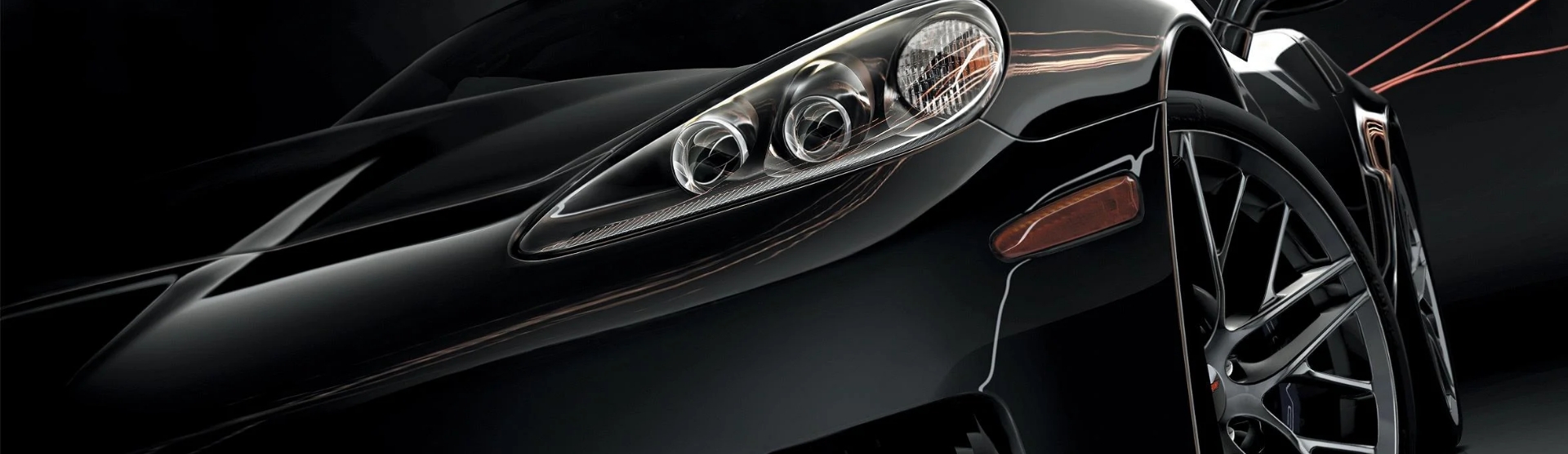
Chevrolet Corvette (Cabriolet) Corvette Convertible (C7) 2018,2019 Specs
General information
Brand
Chevrolet
Model
Corvette (Cabriolet)
Version
Corvette Convertible (C7)
Engine version
ZR1 6.2 V8 (755 Hp)
Year production start
2018
Year production end
2019
Vehicle type
Cabriolet
Horsepower RPM
755 Hp @ 6300 rpm.
Overall length mm - inch
4567 mm
179.8 in.
Doors
2
Engine specs
Designation model
LT5
Cam configuration
VVT
Engine position and orientation
Front, Longitudinal
Cylinders
8
Position of cylinders
V-engine
Displacement (liters)
6162 cm3
376.03 cu. in.
Eng. horsepower RPM
755 Hp @ 6300 rpm.
Horsepower per litre
122.5 Hp/l
Torque Nm RPM lb-ft RPM
969 Nm @ 4400 rpm.
714.7 lb.-ft. @ 4400 rpm.
Bore (mm in)
103.25 mm
4.06 in.
Stroke (mm in)
92 mm
3.62 in.
Compression ratio
10
Fuel delivery system
Direct injection / Multi-point indirect injection
Fuel type
Petrol (Gasoline)
Valvetrain
4
Engine aspiration
Supercharger, Intercooler
Engine oil liters | quarts
9.3 l
9.83 US qt | 8.18 UK qt
Engine coolant
13.1 l
13.84 US qt | 11.53 UK qt
Powertrain architecture
Internal Combustion engine
Engine location
Front, Longitudinal
Transmission and Drive system
Drive configuration
Rear wheel drive
Brakes
Front brakes
Ventilated discs, 394 mm
Rear brakes
Ventilated discs, 388 mm
Anti-lock brake system
ABS (Anti-lock braking system)
Steering
Steering type
Steering rack and pinion
Turning diameter m - ft
12.2 m
40.03 ft.
Suspension
Front suspension
Double wishbone
Rear suspension
Double wishbone
Body / Chassis
Wheels & Tyres
Wheels size
Front wheel tires: 285/30 ZR19
Wheels rims
Front wheel rims: 10J x 19
Exterior
Interior
Safety and Security
Passenger
Passengers seats
2
Trunk space max liter | cu. Ft.
283 l
9.99 cu. ft.
Dimensions
Overall length mm - inch
4567 mm
179.8 in.
Overall width mm -inch
1966 mm
77.4 in.
Overall height mm -inch
1237 mm
48.7 in.
Wheelbase mm - inch
2710 mm
106.69 in.
Track width front mm - inch
1636 mm
64.41 in.
Track width rear mm - inch
1615 mm
63.58 in.
Weights
Fuel tank liters | gallons
70 l
18.49 US gal | 15.4 UK gal
Fuel economy
City l/100km - mpg
18 l/100 km
13.07 US mpg
Highway l/100 km - mpg
12.4 l/100 km
18.97 US mpg
Engine type
8 CYLINDER V-Engine
It's an engine with eight cylinder piston where the cylinders share a common crankshaft and are arranged in a V configuration.
What is the 8 cylinder V-engine displacement: it is in a range between 2926 cc and 8135 cc in recent model line up powertrain.
How much is the power of the 8 cylinder V-engine: the power of the 8 cylinder V-engine is in a range from 125 bhp to 1160 bhp.
Which cars use 8 cylinder V-engine: in recent years several manufactures have been used the V8 engine for 3 main applications: premium, sport cars and lightweight trucks. 8 V engine is the American preferred engine for iconic giant pick-up.
What is the eight cylinder V angle: the majority of V8 engines use a V-angle of 90 degrees. This angle results in good engine balance and low vibrations. The downside is a larger powertrain body that makes the use of this configuration suitable only for longitudinal position and rear drive wheels traction.
V8 engines with a 60 degree V-angle were used in the 1996-1999 by Ford and in 2005-2011 by Volvo. The Ford engine used a 60 degree V-angle because it was based on a V6 engine with a 60 degree V-angle. Both the Ford and Volvo engines were used in transverse engine chassis, which were designed for a front-wheel-drive layout. To reduce the vibrations caused by the unbalanced 60 degree V-angle, Volvo's used a balance shaft and offset split crankpins.
The Rolls-Royce Meteorite tank engine also used a 60 degree V-angle, since it was derived from the 60 degree V12 Rolls-Royce Meteor which in turn was based on the famous Rolls-Royce Merlin V12 engine.
Most V8 engines fitted to road cars use a cross-plane crankshaft, since this configuration produces less vibration due to the perfect primary balance and secondary balance.
The rumbling exhaust sound produced by a typical cross-plane V8 engine is partly due to the uneven firing order within each of the two banks of four cylinders and with separate exhaust systems for each bank of cylinders, this uneven pulsing creates the legendary rumbling sound that is typically of V8 engines.